Monthly: September 2011

24 Sep

Comments Off

The McGorry-Hickie reform controversy: Why has mental health become so political?

by

Yesterday one of Australia’s most prominent psychiatrists, Professor Ian Hickie, wrote an op-ed piece in the SMH titled, “Ignore the critics, public need to back fresh start in mental healthcare”. It is part of a growing controversy around the Gillard government’s apparent big boost to mental health funding in this year’s Budget, in particular around the adoption of the Headspace model of youth early intervention and the downsizing of the Better Access psychology scheme.

In response I wrote this letter to the editor (second one here):

Filed Under: health, psychiatry

20 Sep

Comments Off

Limits of liberal critique: Murdoch, the media & the Manne Quarterly Essay

by

Not so omnipotent anymore
  

Cross-posted from Overland Journal‘s blog and ABC’s The Drum

The ideas of the ruling class are in every epoch the ruling ideas, i.e. the class which is the ruling material force of society, is at the same time its ruling intellectual force. The class which has the means of material production at its disposal, has control at the same time over the means of mental production, so that thereby, generally speaking, the ideas of those who lack the means of mental production are subject to it.

— Karl Marx, The German Ideology (1845)

Robert Manne has done everyone who hates the right-wing, hysterically partisan and mendacious editorial approach of The Australian a considerable service. In the latest Quarterly Essay he has compiled a dossier of some of the Murdoch paper’s most egregious crimes. It is a testament to his scrupulous attention to detail, wide-ranging knowledge of the issues involved and commitment to concretely uncovering systematic (rather than incidental) biases that the paper’s collection of responses by its editorialists and opinion writers limps along using isolated anecdotes and non sequiturs against mountains of evidence marshalled by Manne.

Filed Under: Bob Brown, media, neoliberalism, UK

15 Sep

Comments Off

Australia’s ‘Left’ in government. Part 2: Greens trapped in a prison of their own making

by

Since when did building a climate movement mean cheerleading neoliberal government policies?

In the last post I argued that the deep crisis of the Gillard government is also a crisis of the Greens and the Left more generally. By effectively entering a “Left” government the Greens have replicated the disastrous strategy of Italy’s main party of the Left, Rifondazione Comunista, in joining a centre-Left coalition in the late 2000s.

Continue Reading

13 Sep

Comments Off

Australia’s ‘Left’ in government. Part 1: The graveyard of progressive politics?

by

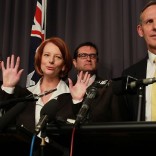
The alliance partners in happier days. Er, two months ago, that is

The stench of death surrounds the Gillard Government.

It is impossible to exaggerate the historic depths to which the ALP has fallen in the polls, with last week’s 27 percent in Newspoll confirming that there would be no “bounce” once the carbon tax announcement was digested by the electorate. Even the temporary revival of sleaze allegations against Craig Thomson was more about the government’s crisis than the substance or seriousness of the “affair of the credit card”. The current race to the bottom on asylum seeker policy, with the High Court and even Tony Abbott managing to hold positions clearly to the Left of the ALP, will undoubtedly create even greater electoral problems for the party’s standing. Continue Reading

11 Sep

Comments Off

Ten years since 9/11: What have progressives really learned about war & Islamophobia?

by


The tenth anniversary of 9/11 has seen TV outlets promo tribute after tribute, where the message is clear: the tragedy of the twin towers requires of us an uncritical outpouring of grief. 

The now ten years old footage, which has been replayed so very many times, is still raw and powerful: people jumping from burning buildings, the voicemails left by those trapped for their loved ones, and the sacrifice of the public servants, in particular fire fighters, who ran in to the buildings to assist and died. But it is of course the images of the collapsing towers that are at the centre, such commanding images that are as potent today as on the first.

Continue Reading