Monthly: June 2012

29 Jun

1 Comment

Help send ‘The Economist’ to Edinburgh

by

Remember when Tad Tietze, Guy Rundle and I edited that book ‘On Utoya’? Well, amongst other things, it inspired the critically acclaimed play ‘The Economist’ written by Tobias Manderson-Galvin and directed by Van Badham.

The people who produced the play, Australian based MKA Theatre of New Writing, in particular their less-than-flush-with-cash actors, need to get to Edinburgh as the play is set to be staged at the Edinburgh Festival. You can help make this possible by contributing to their crowd sourcing funding plans. Donations are tax deductible, and you will be assisting to bring a fantastic and political play to an international audience.

As I have stated on Facebook: I can promise my extreme gratitude, Tad’s public praise for your worthiness, and possibly a big kiss from GRundle on his next visit back home.

And a little about the play:

Continue Reading

Filed Under: Featured

27 Jun

Comments Off

In Greece and Egypt, and in Egypt with Austin

by

This post appeared first at Overland Journal, just after the election weekend.

As the weekend drew to a close in Europe and the Middle East, results of the Greek and Egyptian elections were becoming known. Both countries have seen a revival in progressive struggle and mass action on the streets over the last few years, and yet in both elections conservative forces appear to be the victors. At least for now. The contested nature of politics in both countries make the purportedly ‘tenuous’ nature of Gillard’s minority government (likely to be thrown overboard at the next election, with concrete shoes attached) seem sturdy by comparison.

In Greece, New Democracy (a centre-right party committed to forcing through EU-mandated austerity) has narrowly defeated the radical SYRIZA – in a system where whomever polls the most gains an extra 50 seats in the parliament to help it form government. Yet despite their ‘win’ under this system, things are far from clear as coalitions must be negotiated between parties whose members and voters are polarised on questions of how to deal with the economic crisis and who should bear the brunt of hardship.

Continue Reading

Filed Under: Egypt, Featured, Greece

24 Jun

4 Comments

Paul Howes, foreign workers & the dead-end of union nationalism

by

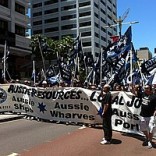
MUA protest against the Enterprise Migration Agreement

I’m reposting a recent piece I wrote for Overland Journal’s blog, in response to the debate over the contentious Enterprise Migration Agreement negotiated between the Gillard government and Gina Rinehart to allow the mining billionaire to import up to 1700 skilled workers from overseas. It was written as an open letter to Paul Howes after an op-ed he wrote. He has indicated he’s interested in responding formally at some point.

For some background on the question of migrant workers in the context of the notorious “British Jobs for British Workers” campaign a few years ago, this excellent essay by UK-based political economist Jane Hardy is highly recommended.

And here is an excerpt from a speech by AMWU Western Australian State Secretary Steve McCartney at a fringe event at the recent ACTU conference.


Continue Reading

19 Jun

1 Comment

Unfree Labour and Slavery’s Second Cousins

by

This post appeared first at Overland Journal.

Slavery. It was a bad thing that happened somewhere else, in the United States or elsewhere. Or so we are told. We don’t often think of Australia as being similarly constructed on the exploitation of unfree labour, and yet the history of the development of local capitalism is exactly that. In their history of Australia, No Paradise for Workers, Ken Buckley and Ted Wheelright rightly call convict labour a ‘second cousin’ of slavery. The early years of the colonies were dominated by our version of slavery, as well as indentured labour. Australia was not just a gaol, but a land where modern development had at its core coerced work.

While wage labour emerged soon after invasion, it was not predominant over convict labour until the mid 1800s. Convicts, along with indentured labourers from India, China and, most particularly, the South Pacific, remained important to capitalist development until the latter part of the nineteenth century. The unfree labour of people from the South Pacific was particularly important in rural Queensland, where other forms of labour were scarce.

Continue Reading

Filed Under: Featured

17 Jun

Comments Off

Allen Frances speaking on psychiatric overdiagnosis this Tuesday in Sydney

by

Professor Allen Frances, head of the American Psychiatric Association’s DSM-IV project in the 1990s, has become the most prominent psychiatric critic of the DSM-5. He has written for a wide range of mainstream publications on this topic (including The New York Times) and has a regular blog at Psychology Today called DSM-5 In Distress, to which I contributed last year.

He’s currently visiting Australia and was interviewed in yesterday’s Sydney Morning Herald on the controversy over psychiatric diagnosis of toddlers.

He’ll be speaking in Sydney on Tuesday night at the Garvan Institute of Medical Research in Darlinghurst, at an event organised by St Vincent’s Hospital. RSVP to MentalHealth@stvincents.com.au to ensure a seat. Entry is by gold coin donation. More details are on the flyer below.

He will also be speaking on “paranoid parenting” at a dinner/talk event the next night, with details here.

Filed Under: Featured, psychiatry

13 Jun

4 Comments

Four points on the Greek situation

by

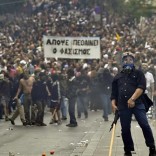
Anti-fascist protest in Thessaloniki last Friday

Here we present a short document by THANASIS KAMPAGIANNIS, a Greek socialist active in the anti-capitalist Antarsya electoral coalition, addressing some of the claims that have been made by supporters of the SYRIZA coalition outside of Greece, and which Left Flank has taken up in the last few posts (here, here and here). We’ve added some Wikipedia links in case people aren’t familiar with the political parties that are the subject of debates. Thanks to Thanasis for giving us permission to repost it. There are some other links of interest at the bottom of the post.

******

1. Where are the elections heading?

The polls till now seem to indicate a lead for SYRIZA, despite the vicious propaganda offensive by the Right. There is a huge push on SYRIZA to be “responsible” and denounce the most radical edges of its programme, most crucially the denunciation of the Memoranda. SYRIZA is talking in an ambiguous way. So, in the presentation of its programme, Tsipras announced that the first measure that a SYRIZA Government would vote on would be the annulment of the Memoranda and of the laws implementing them. The programme itself is full of contradictions: it presents the EU funds as the main financial resource for the Greek economy under SYRIZA, assuming that the funding will not stop even if the Greek state breaks the deal with its lenders. When the senior economists of SYRIZA speak in the media, they are much more honest: they say that the denunciation of the Memoranda will not mean the denunciation of the Loan Treaty, that the Greek state and the Greek banks will keep getting money from the EU and the ECB, that the Greek budget is now on the verge of having surpluses, which means that even if the lenders only give money for the expiring bonds the state will be able to function (with a different taxation system, etc.).

Continue Reading

Filed Under: Featured, Greece

11 Jun

8 Comments

Greece: A political crisis with no easy solution

by

Antarsya banner at demonstration

As background to the recent posts on the situation in Greece, we’re reprinting the translation of an article written by PANOS GARGANAS, editor of the Workers Solidarity newspaper, from his organisation SEK’s Socialism From Below magazine, May-June 2012 issue. This piece was written just after the 6 May elections. Translation is by Costas Todoulos. The original can be found here. Thanks to Nikos Loudos for circulating this.

Panos Garganas analyses the new phase of the double — economic and political — crisis and highlights the importance of anti-capitalist answers.

The elections of the 6th of May opened a new phase in the double economic and political crisis, not only for Greece, but internationally. The ‘Euro-rescuers’ of Greece suffered a shock while the workers and the students who have been resisting austerity across Europe gained new momentum for their struggles. Now, eventually, the question is not whether there is an alternative to the endless austerity of the successive memoranda but in what ways the workers’ movement will develop and enforce this alternative.

Continue Reading

08 Jun

18 Comments

The shock of the not-so-new: Or, the Greek elections & SYRIZA’s rise

by

Alexis Tsipras

Since I last wrote about the situation in Greece the debate I mentioned at the end of my post — about whether all tendencies on the radical Left should get behind the election of a Left government led by SYRIZA — has been hotly debated by various Marxists on the internet. This should not be surprising: The question of which party wins the 17 June election is not an insignificant one. It would be much better if parties committed to breaking with the terms of the socially destructive “bailout” memoranda won out over the old political elites in New Democracy, PASOK and various smaller formations who are committed to maintaining Greece’s position in the Eurozone by acceding to the Troika’s demands for catastrophic austerity measures.

Not only would this be a massive blow to the state and business elites who want the costs of economic crisis to be borne by ordinary people in the Eurozone “periphery”, it would be a clear political signal that Greeks refuse to support parties that want to implement austerity.

Continue Reading