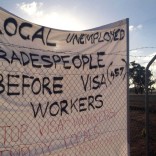
Category: population

01 May

3 Comments

The ALP & the politics of anti-immigration (both kinds)

by

457-Scabs

Cross-posted from Larvatus Prodeo. Thanks to Mark Bahnisch for convincing me to return to this subject.

I have to confess that I couldn’t bring myself to watch Monday’s Four Corners on the scandal of Australia’s “offshore” asylum seeker processing regime. I’m on the Sydney Refugee Action Coalition email list and read horrifying stories from Manus Island on an almost daily basis. Rather than being numbed by this atrocity exhibition I am scared I will simply lose control of my rage and frustration if I have to actually see the human cost on TV.

What makes me doubly angry is that it is a Labor government doing this. Now, I’m one of those hardened Marxist types who expects the reformists to do bad stuff, but there is something debased in this government’s attempts to surpass Howard’s record in “toughness” on refugees. To hear that Labor is now back-flipping on its policy of keeping children out of mainland detention centres just days after the Four Corners special suggests that their strategy is to plough ahead undeterred by basic questions of human decency. Clearly this government is not for turning; at least not in this race to the bottom. Continue Reading

04 Sep

1 Comment

This could take a while: The slow agony of the Gillard government

by

Asylum issues behind them, Gillard and Bowen address, er, new asylum issues

When I wrote the Overland blog entry below, it was just before Newspoll showed a big jump for the ALP to a (still disastrous) 35 percent primary and 47 percent 2PP. As usual many in the commentariat saw this brief upward blip as an excess of swallows presaging summer, replaying the familiar tropes about Gillard having “cleared the decks” on asylum seekers and the carbon tax, and now being able to focus on “Labor” issues like disability and education. Suddenly Tony Abbott had to shape up or face losing the next election. And the chances of Kevin Rudd being an option were evaporating (although one would’ve thought that the ritual character assassination of Rudd in February was enough to make him an improbable choice no matter how bad polls got).

Continue Reading

11 May

Comments Off

How to become part of the political mainstream #47: Learn to dog-whistle

by

Have the Greens decided to join the chorus of anti-immigrant racism that has bedevilled Australian politics for over a century? It seems so, with Bob Brown using the term “queue jumpers” to describe skilled migrants entering the country. Criticising Julia Gillard’s “Malaysian Solution” to deport asylum seekers, he argued:

We know more than 90 per cent of them [asylum seekers] turn out to be [refugees] and we should be integrating them into an Australian economy where we are going to see, I think in the budget tomorrow night potentially, queue jumpers being brought in, at the interest of the mining corporations.

The term “queue jumpers”, of course, has been the stock-in-trade of politicians confecting cries of “unfairness”, even “injustice”, in immigration policy. Not a description of some real queue but an emotional appeal to distract from well-founded bitterness at the real injustices of a society run in the interests of the rich. The trick, therefore, is the displacement of social insecurity into insecurity about borders or ethnicity. To hear it used in this way by Greens politicians must come as a shock to even the most cynical observers of mainstream politics.

Continue Reading

15 Aug

1 Comment

Greens economics (2): The problem with the problem with growth

by


Among progressive environmental thinkers it has become de rigueur to attack economic growth as the main problem leading to ecological destruction and runaway climate change. The argument is put with certain variations, but the central theme is always the same: economic growth is infinite while the planet is finite, and so we cannot afford to keep going in this direction.

The “growth fetish” has also been attacked in a particular critique of neoliberal ideology, which tends to equate GDP growth and increasing consumption with human wellbeing. Contra the thesis of homo economicus, there are masses of data indicating that in rich nations “prosperity” (more broadly understood) cannot be read off headline growth figures. In The Spirit Level, Wilkinson and Pickett demonstrate that in rich countries raw GDP figures have little association with a wide range of health and social indicators, and that the latter are much more closely related to economic equality. Whereas neoliberal thought would have us believe rising inequality is a small price to pay for economic growth “lifting all boats”, in fact even well-off people in more unequal societies suffer from greater problems than their peers in more equal ones. This association even holds true for countries’ action on climate change, which (it is argued) is impeded by more individualistic, consumerism-oriented social organisation.

Continue Reading

22 Jul

2 Comments

Never mind the quality, feel the overcrowding

by

In 2001 the ALP folded in the face of a populist Liberal Party campaign tying concerns over boat people with fear of terrorism. It was then that the term “dog-whistle politics” came into common usage, referring to a political message sent in coded language so that while it was not overtly xenophobic it would be heard and understood by voters susceptible to such divisive politics as speaking to their prejudices.

In 2010 it has been a Labor PM, Julia Gillard, who has most systematically utilised the dog whistle, first by retreading ground well-established by Howard (the “stifling” of debate by political correctness, “understanding” the anxieties of voters over insecure borders and the need to toughen the state’s assault on “people smugglers”). But now she has decided to broaden the debate to one of “sustainable population”.

Continue Reading