Category: trade unions

21 Nov

16 Comments

Taken at face value, Labor is in a lot of trouble

by

It was difficult to know how to approach Paul Howes’ Confessions Of A Faceless Man, his public “diary” of the 2010 election campaign. Was it to be a tell-all insider’s account delivering anecdotes that journalistic efforts would miss? Was it to be a re-evaluation of the problems the first-term federal government got itself into, a thoughtful introspection on how the ALP went from astronomical to disastrous poll ratings in very short order? Or was it to be a meditation on the long-term trajectory of a Labor Party that, as Howes is keen to tell us on his book tour, needs to have some serious debates about “big picture” ideas.

As it turns out, none of the above, and that perhaps explains some of the very critical commentary that has derided Howes for either being one of the vapid apparatchiks who caused this messfor providing little real “insider” insight, and for generally having a really bloody short memory.

Continue Reading

16 Nov

11 Comments

The perils of playing political footsie: The Greens, preferences & the Victorian Election

by

Me in today’s The Drum Unleashed on the ABC website, where I look at the collapse of the Greens’ strategy to secure Liberal Party preferences in some key inner-Melbourne seats. Just why is a Left party playing these games?

Since 2006 the ALP has hammered the fact the Greens are willing to do deals with the Liberals, a line specifically designed to stop traditional Labor supporters from crossing the Rubicon into Greens territory. As the wealth statistics above suggest, class remains a powerful social fact in modern Australia even if it has faded from official discourse. Yet for the ALP, crude class rhetoric about the Greens backing the Tories can help it hold onto its base, even if for purely negative reasons. This ties in with repeated (and unfounded) claims that the Greens represent a privileged, middle-class constituency, indifferent to the needs of working families. Despite the Greens’ protests that voters are smarter than this, or that there really is no difference between Liberal and Labor, the fact remains that they are in a battle for the left wing of Labor’s constituency, where class still holds real meaning.

And:

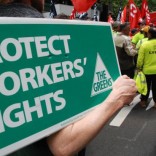
Hence state candidate for Melbourne, Brian Walters [pictured above], can admit amazement the Liberals would risk the election over ideology, yet in the same breath say he thinks “there is a certain logic in the grand conservative Coalition that we are now seeing between Labor and Liberal.” And then, not wanting to cruel potential deals next time, he can add, “How much that holds in the future we will see”. His mixed messages reflect a growing divergence between the kinds of voters and active members the Greens are attracting. The latter, like Walters, tend to be more conservative and seek rapid access to political power through moderation and deal making. Unsurprisingly, Electrical Trades Union leader Dean Mighell has pulled his union’s support away from the Victorian Greens after having backed Bandt to the hilt.

25 Oct

5 Comments

NSW Labor — Degeneration versus resilience

by

[Continued from the last post]

The erosion of the ALP’s long grip on the working class vote in NSW has been spectacular, reflecting the long-term processes that Left Flank has repeatedly drawn attention to. Yet it can still rely on a significant party organisation, and even more so the active endorsement (or at least passive acceptance) of trade union leaders, organisers and delegates to carry its base.

By focusing almost exclusively on the inner-party struggle in Power Crisis, Rodney Cavalier ends up acknowledging but downplaying the importance of how workers in unions helped deliver large ALP votes in NSW in the 2007 state and federal elections, but also how their alienation underpinned Iemma’s destruction and Labor’s electoral collapse in the years since. Iemma won in 2007 in large part because his campaign dovetailed with the powerful Your Rights At Work movement in its portrayal of the Liberal opposition as privileged, nasty, pro-Workchoices Tories. Power privatisation, on the other hand, like Rudd’s later abandonment of climate action, represented a deep betrayal of the hope vested in a party that had already been struggling to prove its relevance to traditional supporters. In both cases Labor “blew its last chance”.

Continue Reading

Filed Under: ALP, Greens, NSW, trade unions

26 Sep

7 Comments

Desperately seeking authority

by

That new paradigm thingy didn’t last long, now, did it?

At least not the world of “kinder, gentler” politics that Tony Abbott was promising. Nor the ability of rural Independent MPs to rise above the fray of deal-making and remain untainted by “old-style” party politics. Nor, of course, the dream of politicians finding more “consensus” rather than squabbling along partisan lines.

Yet there is a paradigm — one of growing social and political polarisation — that is playing itself out in a new way because of the election result, now unable to be hidden behind a mask of apparent governmental stability.

Continue Reading

28 Aug

5 Comments

Politically paid-off? Donations, influence and power in Australia

by

Lest people thought that the pre-election red-baiting of the Greens would stop now that the party’s vote had risen to 11.5 percent and they had gained four new Senators as well as a lower house MP, it has not taken long for a new round of attacks to start. While the media have joined the major parties in courting the three conservative Independent MPs, in particular sanitizing the noxious politics of Bob Katter, already we have been regaled with warnings of Greens extremism and confected shock at Adam Bandt’s history as a socialist in the student network Left Alliance in the 1990s.

But one of the most vexing criticisms has been the donation of a large sum of money (believed to be $325,000) to the Greens campaign by the Victorian branch of the Electrical Trades Union. A significant portion of this ended up with Adam’s campaign. Beyond any right-wing outrage, such as that practiced by the Murdoch press, progressive Sydney Morning Herald columnist Lisa Pryor has also weighed into the debate, broadening it to the question of political donations more generally.

Continue Reading