Category: imperialism

13 Mar

1 Comment

Endless War: Elizabeth at the Sydney STWC forum

by

Feb162003_AntiIraqWarpic26

Iraq – 10 years on:
 Remembering when the world said No to war

Monday March 18 at 6-8.30pm — Mitchell Theatre, Sydney Mechanics School of Arts, 
240 Pitt Street, Sydney

This month marks the tenth anniversary of the Invasion of Iraq. It is a timely reminder not just of the brutality of the war in Iraq, but its length. A decade of war has ravaged the Iraqi people and decimated public infrastructure. In 2004 and 2006 epidemiologists and others associated with Johns Hopkins School of Public Health in the US published research in the international renowned journal The Lancet, estimating the number of ‘excess deaths’ due to the war. The second report states that 650,000 people had died as a result of the war in Iraq, a figure that is likely far greater given the intense fighting that occurred after 2006 and the ongoing health and social crisis in the country. And let us not forget those injured and maimed.

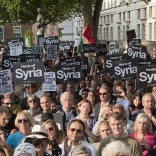
It is also time to recall the the tenth anniversary of the largest protest in Australian history, on February 15 2003, when between 300,000 and 500,000 people protested in central Sydney. That weekend between 600,000 and 900,000 protested across Australia, alongside many millions around the world.

The Sydney Stop the War Coalition is conducting a forum next Monday to remember when the world said no to war, and consider what the situation is in Iraq now and what can be done to prevent more wars. I will be speaking on the panel alongside Donna Mulhearn, who was a human shield during the first ground invasion and has recently returned from another visit to Iraq.

I will be focussing my contribution on the impact and legacy of the protests. While the antiwar movement did not stop the invasion of Iraq from proceeding, it had a significant effect in the outcome of future political events. It shaped international and national politics, and one cannot imagine the comprehensiveness of Howard’s defeat in 2007 without it. For me, an important question is also the difficulties we had of uniting the Global Justice Movement with the anti-war movement in Australia.

Continue Reading

30 Dec

1 Comment

2012 in review: The year that politics disoriented the Left

by

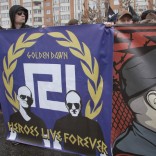
Immigrants protest against Greece’s neo-Nazi Golden Dawn

Just before 2012 closes out, I’m reposting my last Overland blog of the year, which originally appeared here. In some ways it is a summing up of themes we have developed at Left Flank since we started in mid-2010; chiefly in our attempts to present not just a general ideological or theoretical approach to the topics we covered, but to concretely analyse actually existing politics — something that we thought had not been focused on enough by the Australian Marxist Left in recent years. We hope readers have found the blog and our writings elsewhere stimulating because of that focus, and we look forward to developing these ideas more next year. Thanks to all of you for your readership, comments, criticisms and support.

The political prediction business is not one you should engage in unless you’re either willing to repeatedly admit erroneous forecasts (one of Ben Eltham’s most endearing qualities) or to march on obliviously ignoring them (most of the rest of the commentariat). It’s even worse for us Marxists, as we’re notorious for having accurately foretold five out of the last two recessions. The problem is that history unfolds dialectically in the real world, and not simply through a logical derivation from some initial starting point.

Continue Reading

24 Nov

2 Comments

After Gaza ceasefire – a new dynamic in the Middle East

by

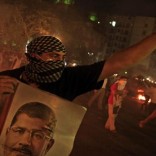
Morsi — the clear winner?

Today we’re posting a follow-up piece by British-based socialist and leading pro-Palestine activist Kevin Ovenden, addressing some of the debates that are beginning to emerge in the wake of the Gaza ceasefire.


The Gaza War — initial thoughts on the outcome

By KEVIN OVENDEN

It is far too early to provide a comprehensive account of the impact of the latest Gaza War on the prospects for the Palestinian struggle, Israel and the region as a whole.

But it is clear that the seven-day war demonstrated both Israel’s continuing preparedness to seek to solve its ongoing crisis and internal political impasse through war, and at the same time the tighter constraints that exist on account of the Arab revolutionary process and continued resistance to imperialism and Israeli aggression.

In response to questions from and out of conversations with many friends, however, here are some schematic observations and opinions that may stimulate a wider discussion.

Continue Reading

22 Nov

3 Comments

Guest post: For those who resist – Palestine is still the issue

by

Egyptians protest against Israel’s assault on Gaza

Left Flank is very pleased to be able to post this extended analysis of Israel’s war on Gaza by British-based socialist Kevin Ovenden, set in its regional and international context. Kevin has been a leading activist in Viva Palestina and narrowly escaped death at the hands of the IDF as part of the first Gaza Flotilla. We previously published his analysis of the UK riots here last year.


What means this war?

By KEVIN OVENDEN

The response from Western capitals and their allies to Israel’s latest war on Gaza was as expected.

There was no hand-wringing about a “no-fly zone” to protect civilians; no clichéd demarche from Paris calling for “humanitarian corridors”; no emergency London or Doha conference to agree “non-lethal” defence supplies to the people of Gaza; no total or even token sanctions on Israel; no calls for Binyamin Netanyahu to step down; no media castigation of the “regime” in Tel Aviv; no arms or billions in largesse flowing from Western allies in the Persian Gulf and Turkey to those fighting an illegitimate, murderous aggressor.

Instead, there was full-throated support for Israel. Britain’s Foreign Secretary William Hague led the pack in laying “principal responsibility” for the aggression on its victims — the Hamas government in Gaza and those who elected it. His subsequent advice that Israel risked “losing international support” through a ground invasion merely indicated the West’s preferred parameters for this bout of slaughter.

All predictable, perhaps wearily so. Why then rehearse this litany of hypocrisy? Because if we become inured to it, let it stand as a harsh fact of life in a cynical world, then unwittingly we allow the West and its allies to shift the narrative in the Middle East, to frame events and to determine which questions will be asked and which buried. And not just there.

Continue Reading

17 Feb

Comments Off

On Finkelstein, the BDS, one-state solutions & the problem with Gandhi’s strategy

by

Palestinians cross over the Syrian-Israeli border, May 2011

I’ve had a chance to look at Norman Finkelstein’s recent controversial statements about Left strategy over the question of the BDS. Finkelstein, a brilliant critic of Israel’s treatment of the Palestinians, has for some time been highly critical of the international BDS campaign, in particular because he believes it implicitly calls for the end of Israel (a “one-state solution” in the parlance).

Continue Reading

01 Feb

Comments Off

With ‘friends’ like Western governments, the Arab Spring doesn’t need enemies

by

Protesters in Tahrir unfurl the flag of the Syrian rebellion

This article first appeared on the ABC Drum website yesterday.

One of the abiding images of the Arab Spring has been an aerial view of Tahrir Square in Cairo, brimming with thousands and perhaps hundreds of thousands of protesters. This image has returned most spectacularly on the first anniversary of the 25 January uprising, with Tahrir not just full but overflowing onto dozens of streets, boulevards and bridges, the biggest mobilisation yet. It is in such displays that the term “people power” takes on real meaning, when the great mass of humanity takes an active role in making history.

Continue Reading

31 May

Comments Off

Revenge, apparently a dish only properly served by the United States military

by

>

Pakistani tribesmen offer funeral prayers after 60 people killed in two US missile strikes in 2009 
Now, The Australian can be depended on to run some of the most reactionary arguments one is likely to see in the Australian press in its notorious op-ed pages. But as a keen follower of the Egyptian Revolution I was drawn to today’s reprinted offering from Washington Post Writers’ Group member David Ignatius, entitled “Arab progress not served by revenge”.

With Egypt’s brutal former dictator Hosni Mubarak facing prosecution for conspiring to kill unarmed protesters, Ignatius is deeply uncomfortable with the possible outcome of this example of “prosecutorial zeal”. Quoting Milton’s “Paradise Lost” no less — “Revenge, at first though sweet, Bitter ere long, back on itself recoils” — he demands “safeguards against vindictive prosecution,” because, er…
The greater danger is that Egyptian and international investors will steer clear of the country if they think doing business there might expose them to legal risks.
US Democrat senator John Kerry had it right when he told a gathering of the Woodrow Wilson Centre’s trustees last week that a vengeful legal assault on Mubarak would be an “enormous mistake”. The biggest cost, Kerry said, is that it would undermine the economic strategy of innovation, investment and entrepreneurship that was the overlooked centrepiece of US President Barack Obama’s big speech on the Middle East.
So a dictator can order the slaughter of his people but we shouldn’t let abstractions like justice and human rights get in the way of doing business. Mubarak certainly didn’t.
But for someone so appalled by revenge, it was curious to find Ignatius writing in the Washington Post on 4 February 2010 about “Revenge on the Taliban, from 10,000 feet”. Invoking suicide bombings against US and Pakistani targets as justification, he speaks glowingly of newfound cooperation between the two nations around “a classic piece of battlefield advice: Don’t get mad, get even.”
Ignatius doesn’t whitewash what this really means:
Though the Predators launch their Hellfire missiles from the lofty altitude of 10,000 feet, make no mistake: This is an intense and unrelenting campaign of assassination. It continued Tuesday with a fusillade of at least 17 missiles in North Waziristan, in an apparent assault on senior al-Qaeda and Taliban fighters.
The Predator blitz this year followed a Dec. 30 suicide attack on a CIA base in Khost, Afghanistan, that had been active in targeting the Taliban insurgents across the border. That attack killed eight CIA personnel and left the agency eager to settle scores. The agency, backed by Pakistani intelligence, has done just that. [Emphases added]
I don’t suppose we can expect Ignatius to be equally outraged by “vindictive prosecutions” against anti-regime activists like Amr Abdallah Elbihiry or Maikel Nabil, still being carried out by the Egyptian military. Or the summoning for questioning of campaigning blogger and journalist Hossam El-Hamalawy and TV presenter Reem Maged after El-Hamalawy held the head of the military police responsible for the torture of activists on Maged’s show (like that’s news or something).*
Ignatius is appalled when revolutions go too far, calling for a “path to reconciliation” or “there will be blood”. Shame he couldn’t find that spirit of reconciliation before celebrating bloody US operations along the Pakistan-Afghanistan border.

*UPDATE: Happily, it appears that the two were summoned in order to provide evidence against alleged torture by military police. Let’s hope they did so in the spirit of reconciliation

Filed Under: Egypt, imperialism

03 May

Comments Off

Green Fear: staying out of the ‘no-go zone’ of Australia-US-Israel relations

by

>

Marrickville Council may have backed off supporting the Israel BDS campaign but by highlighting the plight of the Palestinians, the Council’s initiative in this area, and the pro-BDS stance of the NSW Greens, has ensured that this will only be the beginning of the debate, not least of all within the Greens themselves. The Australian Greens may pride themselves on confronting the “inconvenient truths” of climate change but when it comes to exposing the inconvenient truths of the plight of the Palestinian people (as the BDS campaign does), some in the party are ducking for cover.

Led by elements in the Victorian Greens and the national Greens leadership, the move is on to force NSW Greens to back away from its BDS policy. There are those who genuinely feel the BDS campaign is counterproductive, imperilling the achievement of peace between Israelis and Palestinians, those who are afraid the issue will divide the party, and at its most basic level, those who fear a loss of votes.  For many in the party, the BDS campaign is trouble, and that is enough. The Victorian Greens are trying to limit the debate to the question of process — the extent to which NSW is out of step with national policy and decisions. There is resistance to discussing the merit of the BDS issue itself.
But the Great Fear emerging among some in the Greens is wider than the BDS. It is the fear of the political cost involved in breaching the “separation wall” and entering the “no-go zone” established by the major political parties, the defence and foreign policy establishments, and elements in the mainstream media. That no-go zone is any attempt at realistic or insightful criticism, or analysis, of the Alliance between Australia and its best mate Uncle Sam, and as part of that deal, any principled criticism of the actions of Uncle Sam’s best mate, Israel.
The demonstration of this lies not just with the inner-party reaction to BDS but the Afghan War debate in parliament last year. That five Greens senators and one Greens MHR could get up in the parliament and not criticise the Australia-US alliance, the whole reason Australia is in Afghanistan, was somewhat bizarre.[i] Notwithstanding some good political points made in the speeches, this was akin to holding a debate about global warming and not mentioning carbon. The speeches in some respects were not at odds with continuing support for the US Alliance, with the Iraq and Afghan wars, like Vietnam before them, seen as “mistakes” imperilling the alliance’s effectiveness.
To understand what the Greens are up against, we need an appreciation of the entrenched nature of the Australia-US-Israel relationship, which has protected it from critical analysis in Australian politics and sections of the mainstream media. Historian Peter Edwards has pointed out that the Australia-US alliance  “has become a political institution in its own right comparable with a political party or the monarchy”[ii]. It has certainly become a part of Canberra’s constitutional landscape, with Australia’s military-intelligence complex clustering around the Australia-American memorial at Russell and holding down one of the points of the parliamentary triangle.
Following US policy in privileging Israel in its conflict with Palestinians is part of this architecture. This was demonstrated by the Australian government falling into line and helping the blocking in the UN of the Goldstone Report on the 2008-9 Israeli invasion of Gaza, an egregious act in no way justified by Goldstone’s recent reservations, repudiated by his report’s co-authors.[iii] And this stance was earlier demonstrated by Australia’s official response at the time of the Gaza assault, by then Acting Prime Minister Julia Gillard, which singled out Hamas for criticism but made no comment on the disproportionate use of force by Israel.[iv] To Gillard and the Labor government, following the US on Gaza meant accepting Uncle Sam’s realpolitik, and underlying racial prejudice: a Palestinian life is not worth that of an Israeli. And of course not a peep out of the Australian government when the US recently used its veto to protect Israel from criticism in the UN Security Council over West Bank settlement expansion.
Support for both the US Alliance, and the US’s pro-Israel stance, is reinforced by Australian participation in the closed door, “Chatham House Rules”-based Australian-American Leadership Dialogue and Australia-Israel Leadership Forum.[v] Participation of politicians past and present in these secretive dialogues, aimed at providing discursive and cultural support for US foreign policy, and for Israel, is predictable. But it is shameful that Australian academics and journalists participate in contradiction with the ethics of transparency and open debate that are supposed to be at the core of their professions.
The McCarthyite campaign of ignorance and vilification directed at NSW Greens over the non-violent BDS campaign shows the fate that awaits those who seek to breach this “separation wall”, and for some in the Greens seeking to enter the no-go zone has too high a political cost. But there are those in the Greens, in NSW in particular, who are unlikely to back down, as demonstrated in Marrickville Mayor Fiona Byrne’s courageous, dignified and principled stance, along with two other Greens councillors, in resisting her council’s retraction of support for BDS.
The “blue” within the Greens is just beginning, but the Palestinians are unlikely to wait for the Australian Greens or anybody else to decide what’s good for them. The remarkable Arab Awakening is influencing the Palestinian territories, most recently in pushing Hamas and Fatah into some sort of agreement. It is unlikely to stop there, promising a new popular uprising against Israeli occupation and blockade. This may spread to the Palestinian population within Israel itself, and who knows, maybe also to those non-Arab Israelis who are resisting what Israeli academic, and BDS supporter, Neve Gordon has labelled the “proto-fascist mindset” of the Israeli government.[vi] Indeed it could even begin within Israel. If and when this uprising comes, it is likely to be a game-changer.

[ii] Peter Edwards, “Permanent Friends: Historical reflections on the Australian-American Alliance”, Lowy Institute, 2005: http://www.lowyinstitute.org
[vi] “BDS campaign wants Israel to abide by international law”; http://www.guardian.co.uk/world/2010/jul/11/israeli-academic-boycott-commentary

Filed Under: Greens, imperialism, NSW, Palestine

24 Mar

Comments Off

Western military intervention in Libya: There. Is. No. Alternative. Or is there?

by

>

Egypt’s revolution — why has Libya been so different?

If there is one thought experiment that liberal supporters of Western military intervention in Libya ruled out of court (even forbade) it was the possibility that there were other social actors and strategies that could seriously affect the outcome of the battle between forces loyal to Gaddafi and the revolutionaries. For days we were told that a “massacre” or even “genocide” was imminent and that it could only averted by giving a vacillating United States some backbone to start a war help establish a no-fly zone. All considerations of the history of such actions had to be dismissed because of the urgency with which “something must be done” (the “something” meaning only one thing).

There were two groups who stood to benefit most from embellishing accounts of the impending humanitarian disaster in the most alarmist way possible: Western powers keen on intervening and the leadership of the uprising who saw this as the best option in their struggle. Our rulers have a long track record in propaganda designed to stoke popular passions for war, unafraid to tell plain lies if need be (the “Kuwaiti babies torn from their incubators” story was a prominent myth used to build support for the 1990-1 Gulf War).
A credible, pro-war Time report has pointed out that the talk of “genocide” was part of an Obama Administration attempt to “rehabilitate the doctrine of humanitarian intervention eight years after the Iraq war discredited U.S.-led military actions abroad.” The problem, however, is that “Gaddafi hasn’t done enough to justify humanitarian intervention—despite their rhetoric to the contrary, the administration and human rights organizations admit that reports of potential war crimes remain unconfirmed.”
The ability for the U.S. to muster international force to prevent thugs from killing innocent people is important. But the president and some of his advisers are so eager to rehabilitate the idea of preventive intervention that they’re exaggerating the violence they say they are intervening to prevent in Libya. “The effort to shoe-horn this into an imminent genocide model is strained,” says one senior administration official.
Indeed, Obama’s speech announcing US participation in the no-fly zone was phrased very much in the terminology of preventive war so favoured by Bush Jr.

Contradictions of the Libyan revolution

But the question of why the Libyan rebels, initially over-certain in their claims to represent the national-popular collective will, turned to such apocalyptic language more befitting the likes of Gaddafi himself is more interesting.
Libya lies geographically between Tunisia and Egypt, the sites of the two most advanced and complex revolutionary processes to have arisen in the Arab world in recent months. But its rebellion, while quickly achieving control of large parts of the country, didn’t play out the same way. Instead, there were rapid defections of significant sections of Gaddafi’s state structure (including many ambassadors) to the opposition. But the country remained geographically divided, in part because Gaddafi had cannily built networks of patronage through such mechanisms as provision of state employment in Tripoli, funded by oil revenues.
At this point the radicalisation hit a crossroads: To find a way to foment an urban uprising in Gaddafi’s strongholds or to pursue a more conventional military strategy. The directions chosen reflected not just the politics of the revolution’s self-proclaimed leaders (some until recently were key players in the dictatorship) but the response they received from the “International Community”:
Libya’s Transitional National Council (TNC), the body that grew out of the revolution, made a series of simple demands in the first crucial days of the uprising. It asked for the recognition of the TNC, access to the billions in sequestrated regime funds in order to buy weapons and other crucial supplies, and an immediate halt to the “mercenary flights” that provided Gaddafi’s regime with its foot soldiers.
For all those who argued that “something” must be done, such concrete steps could have made a massive difference to the balance of forces. So what was the response?
Western governments refused to accept even one of these demands. They even objected to weapons sales as they said these could fall into the hands of “Islamist terrorists.”
Instead, Western powers put a number of conditions on the revolution.
They demanded that any future Libyan government would honour all contracts signed by Gaddafi, including oil concessions.
They demanded that the strict repression of “Islamist” movements continue, and that any future government maintain Libya’s role as a guardian against African migration into southern Europe.
The West, in effect, blackmailed the revolution.
It is little wonder that the more conventional view of military engagement began to exert a greater hold on the revolution, especially once Gaddafi started to stage a serious fightback. Unlike Egypt, where the generals didn’t feel confident they could mobilise their troops without risking a military rebellion along class lines, in Libya a significant section of military leaders felt confident to throw their lot in with Gaddafi. In such a situation, a much more radical politics from below would be necessary to overcome the impasse created by a military asymmetry.
The seeking of an alliance with the West itself then creates new pressures on what type of politics the revolution’s leaders can pursue. As the rebellion’s foreign representatives rushed about from Western leader to Western leader, they would have had to adapt their message to get support.
With Western bombs smashing into the country, the performance of Libya’s former US ambassador on Al-Jazeera last night was ugly to watch. From the 19:00 min mark of the video he first dismisses a question about why Arab nations rather than the West can’t get involved (because Arab nations could never succeed) and then downplays the level of violence in US-backed Bahrain and Yemen, to make the case that Libya is an exception on moral grounds. Not much revolutionary solidarity at play there.

No-fly zone achieving what, exactly?

The disturbing thing for pro-interventionists is that the West’s war effort has so far not produced anything resembling a clear cut advantage for the rebels, apart from obligatory TV footage of them welcoming the fighter jets with cheers. A detailed report from Time suggests that Gaddafi has so far made substantial advances even while the no-fly zone operates, and that cracks are opening inside the revolutionary camp between more grassroots activists and ex-regime leaders. Already there is talk of the West settling for a partition as the best outcome, and one can only imagine how that will be policed in the long term. It is uncertainties such as these — coupled to the fear of mission creep and quagmire — that have exacerbated tensions within the Western camp.
More broadly, the immediate effect of Western intervention on the Arab revolutions has been to send the message to US allies that they can crack down harder on protest movements. For all its talk of moral purpose in Libya, the US continues to let atrocities occur in other states with barely a word of public criticism. This is not just a case of gross hypocrisy (although it is that). The double standard arises because the various moves and counter-moves being played out are part of Western efforts to reassert hegemony in the region through a mixture of outright force and “soft power” to shore up favoured dictators and/or pliant reformists. But the fact that they are so weakened — not just by the Arab uprisings but the grinding global recession of the last two years — means that their attempts to get back on top are fraught with massive risk. The high-stakes nature of the game also means that the human toll of their actions is likely to be much greater.
So if we’re not demanding more bombs be dropped on Libya, how might an anti-imperialist Left define some things “our” governments could do that would really help the rebellion? We could start with the TNC requests that the West refused, but Jamie Allinson has some other suggestions that I thought we should be raising.
Release the Gaddafi regime funds to the revolutionaries and allow them to buy weapons

Condemn the Saudi (GCC) invasion of Bahrain, cut ties with both regimes and with Yemen’s Ali Abdallah Saleh — removing also the military aid to his regime. Cancel all military contracts with them.

Allow Benghazi to become an open port for Arab — or other — revolutionary volunteers to join the fight.

Of course these won’t satisfy those on the Left who equate “doing something” with raining death and destruction on MENA countries, but they would be far more useful to both the Libyan rebels and the Arab revolutions more generally. 

Filed Under: Egypt, imperialism, Libya, revolution