Category: Egypt

30 Dec

1 Comment

2012 in review: The year that politics disoriented the Left

by

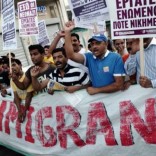
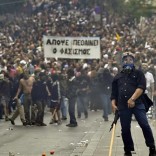
Immigrants protest against Greece’s neo-Nazi Golden Dawn

Just before 2012 closes out, I’m reposting my last Overland blog of the year, which originally appeared here. In some ways it is a summing up of themes we have developed at Left Flank since we started in mid-2010; chiefly in our attempts to present not just a general ideological or theoretical approach to the topics we covered, but to concretely analyse actually existing politics — something that we thought had not been focused on enough by the Australian Marxist Left in recent years. We hope readers have found the blog and our writings elsewhere stimulating because of that focus, and we look forward to developing these ideas more next year. Thanks to all of you for your readership, comments, criticisms and support.

The political prediction business is not one you should engage in unless you’re either willing to repeatedly admit erroneous forecasts (one of Ben Eltham’s most endearing qualities) or to march on obliviously ignoring them (most of the rest of the commentariat). It’s even worse for us Marxists, as we’re notorious for having accurately foretold five out of the last two recessions. The problem is that history unfolds dialectically in the real world, and not simply through a logical derivation from some initial starting point.

Continue Reading

24 Nov

2 Comments

After Gaza ceasefire – a new dynamic in the Middle East

by

Morsi — the clear winner?

Today we’re posting a follow-up piece by British-based socialist and leading pro-Palestine activist Kevin Ovenden, addressing some of the debates that are beginning to emerge in the wake of the Gaza ceasefire.


The Gaza War — initial thoughts on the outcome

By KEVIN OVENDEN

It is far too early to provide a comprehensive account of the impact of the latest Gaza War on the prospects for the Palestinian struggle, Israel and the region as a whole.

But it is clear that the seven-day war demonstrated both Israel’s continuing preparedness to seek to solve its ongoing crisis and internal political impasse through war, and at the same time the tighter constraints that exist on account of the Arab revolutionary process and continued resistance to imperialism and Israeli aggression.

In response to questions from and out of conversations with many friends, however, here are some schematic observations and opinions that may stimulate a wider discussion.

Continue Reading

22 Nov

3 Comments

Guest post: For those who resist – Palestine is still the issue

by

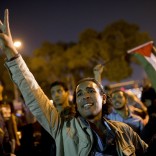
Egyptians protest against Israel’s assault on Gaza

Left Flank is very pleased to be able to post this extended analysis of Israel’s war on Gaza by British-based socialist Kevin Ovenden, set in its regional and international context. Kevin has been a leading activist in Viva Palestina and narrowly escaped death at the hands of the IDF as part of the first Gaza Flotilla. We previously published his analysis of the UK riots here last year.


What means this war?

By KEVIN OVENDEN

The response from Western capitals and their allies to Israel’s latest war on Gaza was as expected.

There was no hand-wringing about a “no-fly zone” to protect civilians; no clichéd demarche from Paris calling for “humanitarian corridors”; no emergency London or Doha conference to agree “non-lethal” defence supplies to the people of Gaza; no total or even token sanctions on Israel; no calls for Binyamin Netanyahu to step down; no media castigation of the “regime” in Tel Aviv; no arms or billions in largesse flowing from Western allies in the Persian Gulf and Turkey to those fighting an illegitimate, murderous aggressor.

Instead, there was full-throated support for Israel. Britain’s Foreign Secretary William Hague led the pack in laying “principal responsibility” for the aggression on its victims — the Hamas government in Gaza and those who elected it. His subsequent advice that Israel risked “losing international support” through a ground invasion merely indicated the West’s preferred parameters for this bout of slaughter.

All predictable, perhaps wearily so. Why then rehearse this litany of hypocrisy? Because if we become inured to it, let it stand as a harsh fact of life in a cynical world, then unwittingly we allow the West and its allies to shift the narrative in the Middle East, to frame events and to determine which questions will be asked and which buried. And not just there.

Continue Reading

19 Nov

10 Comments

Gaza: How did taking the side of the oppressed get so hard?

by

The Australian Greens are deeply worried about the civilian death toll in Israel and Palestine, and urge both sides of the conflict to put down their weapons and respect a ceasefire.

“The human suffering is too great and the continued recourse to violence has done nothing for peace,” Australian Greens Leader, Senator Christine Milne, said.

“We support a two-state solution and urge the Government to support Palestine’s bid for a UN non-member statehood status.

“Now that we have a seat at the UN Security Council, Australia needs to step up to this role and take a more considered and independent position. Calling for ‘de-escalation’ is not enough – a ceasefire is what is needed.”

—Australian Greens media release, 16 November

The goal of the operation is to send Gaza back to the Middle Ages. Only then will Israel be calm for 40 years.

—Israel’s Interior Minister, Eli Yishai, 17 November

There should be no electricity in Gaza, no gasoline or moving vehicles, nothing. Then they’d really call for a ceasefire.

—Gilad Sharon, son of former Israeli PM Ariel Sharon, in the Jerusalem Post, 18 November

In case you thought that Australian politics was all about interminable partisan sledging between the Right (a.k.a. Tony Abbott) and the Left (a.k.a. Julia Gillard and her Greens allies), along comes Israel’s attack on Gaza to unsettle things. Not because it has reproduced the same Right-Left divide, but because it reveals the near-unanimity of our political class in refusing to condemn Israeli aggression.

Continue Reading

27 Jun

Comments Off

In Greece and Egypt, and in Egypt with Austin

by

This post appeared first at Overland Journal, just after the election weekend.

As the weekend drew to a close in Europe and the Middle East, results of the Greek and Egyptian elections were becoming known. Both countries have seen a revival in progressive struggle and mass action on the streets over the last few years, and yet in both elections conservative forces appear to be the victors. At least for now. The contested nature of politics in both countries make the purportedly ‘tenuous’ nature of Gillard’s minority government (likely to be thrown overboard at the next election, with concrete shoes attached) seem sturdy by comparison.

In Greece, New Democracy (a centre-right party committed to forcing through EU-mandated austerity) has narrowly defeated the radical SYRIZA – in a system where whomever polls the most gains an extra 50 seats in the parliament to help it form government. Yet despite their ‘win’ under this system, things are far from clear as coalitions must be negotiated between parties whose members and voters are polarised on questions of how to deal with the economic crisis and who should bear the brunt of hardship.

Continue Reading

Filed Under: Egypt, Featured, Greece

01 Feb

Comments Off

With ‘friends’ like Western governments, the Arab Spring doesn’t need enemies

by

Protesters in Tahrir unfurl the flag of the Syrian rebellion

This article first appeared on the ABC Drum website yesterday.

One of the abiding images of the Arab Spring has been an aerial view of Tahrir Square in Cairo, brimming with thousands and perhaps hundreds of thousands of protesters. This image has returned most spectacularly on the first anniversary of the 25 January uprising, with Tahrir not just full but overflowing onto dozens of streets, boulevards and bridges, the biggest mobilisation yet. It is in such displays that the term “people power” takes on real meaning, when the great mass of humanity takes an active role in making history.

Continue Reading

19 Nov

Comments Off

End times for democracy? How the 1% staged a coup & why worse is yet to come

by

‘Don’t forget who runs your economy now.’

For the 1 percent who rule society, democracy seems more than ever a hindrance to ensuring that the most calamitous economic crisis since the 1930s is paid for by the 99 percent below them. The most obvious expression of this is the installation of unelected technocrats as prime minister in Greece and Italy, in order to keep the countries’ governments firmly on the path of ever-deeper austerity programs designed to keep those ubiquitous “markets” happy.

It is here that we can see Lenin’s statement that “politics is a concentrated expression of economics” playing itself out concretely as a crisis of production and debt has mutated into a crisis of the political class, the state, and national sovereignty.

Continue Reading

13 Oct

Comments Off

Occupy Everywhere: Against capitalism and its paid prizefighters

by

During protests in Egypt to overthrow Mubarak, a protester displayed a handmade sign that said ‘Egypt Supports Wisconsin Workers – One World, One Pain’. 

The sign broke all the rules: it was terribly written, hard to read even up close, had a confusing graphic of a wrench and cog within the writing, and the text went in two directions. Yet it, more than any other, flooded my Facebook and Twitter feeds.

In recent weeks as the Occupy Wall Street protests have grown, comparisons between them and the Arab Spring have been made, with some noting ‘though the two movements have many differences, they share the same fundamental drivers: a deep sense of injustice and invisibility’.

Continue Reading

08 Jun

Comments Off

Islamism, secularism & Left strategy: A debate at Overland Journal & blog

by

I knew I’d get in trouble for writing a post entitled “Who’s afraid of the Muslim Brotherhood”. And so it was that Overland’s editorial overlord, Jeff Sparrow, roped me in to debate Michael Brull on the topic of “Political Islam is not a friend of the Left”. My contribution has just come out in Overland 203.

You can follow the debate like this: Michael writes the affirmative case here, and then I respond in the negative here. Michael replies here and I respond here. There are copious references to examine here.

Better yet, rush out to buy a print copy (issue 203 has all sorts of other cool stuff in it) or — best of all — why not subscribe. You won’t be disappointed!

To help launch this issue, Overland’s Clare Strahan has interviewed both of us about more recent developments, what inspires us to be writers and on the Left, and you even get to find out what my favourite song ever is. What more could you want?

Filed Under: Egypt, Islamism, secularism

31 May

Comments Off

Revenge, apparently a dish only properly served by the United States military

by

>

Pakistani tribesmen offer funeral prayers after 60 people killed in two US missile strikes in 2009 
Now, The Australian can be depended on to run some of the most reactionary arguments one is likely to see in the Australian press in its notorious op-ed pages. But as a keen follower of the Egyptian Revolution I was drawn to today’s reprinted offering from Washington Post Writers’ Group member David Ignatius, entitled “Arab progress not served by revenge”.

With Egypt’s brutal former dictator Hosni Mubarak facing prosecution for conspiring to kill unarmed protesters, Ignatius is deeply uncomfortable with the possible outcome of this example of “prosecutorial zeal”. Quoting Milton’s “Paradise Lost” no less — “Revenge, at first though sweet, Bitter ere long, back on itself recoils” — he demands “safeguards against vindictive prosecution,” because, er…
The greater danger is that Egyptian and international investors will steer clear of the country if they think doing business there might expose them to legal risks.
US Democrat senator John Kerry had it right when he told a gathering of the Woodrow Wilson Centre’s trustees last week that a vengeful legal assault on Mubarak would be an “enormous mistake”. The biggest cost, Kerry said, is that it would undermine the economic strategy of innovation, investment and entrepreneurship that was the overlooked centrepiece of US President Barack Obama’s big speech on the Middle East.
So a dictator can order the slaughter of his people but we shouldn’t let abstractions like justice and human rights get in the way of doing business. Mubarak certainly didn’t.
But for someone so appalled by revenge, it was curious to find Ignatius writing in the Washington Post on 4 February 2010 about “Revenge on the Taliban, from 10,000 feet”. Invoking suicide bombings against US and Pakistani targets as justification, he speaks glowingly of newfound cooperation between the two nations around “a classic piece of battlefield advice: Don’t get mad, get even.”
Ignatius doesn’t whitewash what this really means:
Though the Predators launch their Hellfire missiles from the lofty altitude of 10,000 feet, make no mistake: This is an intense and unrelenting campaign of assassination. It continued Tuesday with a fusillade of at least 17 missiles in North Waziristan, in an apparent assault on senior al-Qaeda and Taliban fighters.
The Predator blitz this year followed a Dec. 30 suicide attack on a CIA base in Khost, Afghanistan, that had been active in targeting the Taliban insurgents across the border. That attack killed eight CIA personnel and left the agency eager to settle scores. The agency, backed by Pakistani intelligence, has done just that. [Emphases added]
I don’t suppose we can expect Ignatius to be equally outraged by “vindictive prosecutions” against anti-regime activists like Amr Abdallah Elbihiry or Maikel Nabil, still being carried out by the Egyptian military. Or the summoning for questioning of campaigning blogger and journalist Hossam El-Hamalawy and TV presenter Reem Maged after El-Hamalawy held the head of the military police responsible for the torture of activists on Maged’s show (like that’s news or something).*
Ignatius is appalled when revolutions go too far, calling for a “path to reconciliation” or “there will be blood”. Shame he couldn’t find that spirit of reconciliation before celebrating bloody US operations along the Pakistan-Afghanistan border.

*UPDATE: Happily, it appears that the two were summoned in order to provide evidence against alleged torture by military police. Let’s hope they did so in the spirit of reconciliation

Filed Under: Egypt, imperialism