Category: Iraq

21 Mar

Comments Off

Iraq and the Australian anti-war movement

by

AUSTRALIA-IRAQ-PROTEST

This is the speech I gave on Monday this week, at the forum ‘IRAQ 10 years on: Remembering when the world said NO to war’ — organised by the Sydney Stop the War Coalition. 

Soon after the fall of the Berlin wall, American political scientist Francis Fukuyama declared that the moment signalled ‘the end of history’ and the absence of alternatives to the neoliberal hegemony. For ruling elites, Margaret Thatcher’s assertion ‘there is no alternative’ was unquestioned. The next decade in Australia saw John Howard in office continuing to roll out the ‘economic rationalism’ first introduced by Bob Hawke and Paul Keating, in addition to dog whistling to his Right – taking up the policies of Pauline Hanson and regaining much of the constituency he’d lost to One Nation. Politics seemed grim, and many on the left were despondent. But in November 1999, a watershed moment occurred in the heart of world capitalism – on the streets of Seattle, in the United States – when Teamster unionists, environmentalists dressed as Turtles and many others joined forces to dispute that there was no alternative. Their target was the World Trade Organisation meeting, which was negotiating a new round of free trade agreements, and their blockades of the venue and mass rallies shut it down.

That story of dissent against multinational corporations, and the government structures that facilitate them, was not just to be the story of the US however; or only the story of Prague, Davos, Genoa or Gleneagles. It is our story too. Thirteen years ago we saw magnificent protests in Australia that both criticised the way the world was, as well as imagined a different future. ‘Another World Is Possible’ was the slogan of the World Social Forum, and it reflected sentiment around the globe. In Australia the Global Justice Movement exploded at the s11 protests, when we blockaded the Asia-Pacific Summit of the World Economic Forum at Crown Casino in Melbourne – and 20,000 people shut it down. It was a protest that said no to the ruling class agenda of prioritising profits above people and the planet, and it was a celebration of the diversity of those who imagined a different world. Similar events and movements across the globe questioned the structures and the priorities of capitalism – if in confused ways at times – and it was the formation of a global anti-systemic movement.

Continue Reading

13 Mar

1 Comment

Endless War: Elizabeth at the Sydney STWC forum

by

Feb162003_AntiIraqWarpic26

Iraq – 10 years on:
 Remembering when the world said No to war

Monday March 18 at 6-8.30pm — Mitchell Theatre, Sydney Mechanics School of Arts, 
240 Pitt Street, Sydney

This month marks the tenth anniversary of the Invasion of Iraq. It is a timely reminder not just of the brutality of the war in Iraq, but its length. A decade of war has ravaged the Iraqi people and decimated public infrastructure. In 2004 and 2006 epidemiologists and others associated with Johns Hopkins School of Public Health in the US published research in the international renowned journal The Lancet, estimating the number of ‘excess deaths’ due to the war. The second report states that 650,000 people had died as a result of the war in Iraq, a figure that is likely far greater given the intense fighting that occurred after 2006 and the ongoing health and social crisis in the country. And let us not forget those injured and maimed.

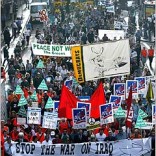
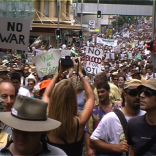
It is also time to recall the the tenth anniversary of the largest protest in Australian history, on February 15 2003, when between 300,000 and 500,000 people protested in central Sydney. That weekend between 600,000 and 900,000 protested across Australia, alongside many millions around the world.

The Sydney Stop the War Coalition is conducting a forum next Monday to remember when the world said no to war, and consider what the situation is in Iraq now and what can be done to prevent more wars. I will be speaking on the panel alongside Donna Mulhearn, who was a human shield during the first ground invasion and has recently returned from another visit to Iraq.

I will be focussing my contribution on the impact and legacy of the protests. While the antiwar movement did not stop the invasion of Iraq from proceeding, it had a significant effect in the outcome of future political events. It shaped international and national politics, and one cannot imagine the comprehensiveness of Howard’s defeat in 2007 without it. For me, an important question is also the difficulties we had of uniting the Global Justice Movement with the anti-war movement in Australia.

Continue Reading

11 Sep

Comments Off

Ten years since 9/11: What have progressives really learned about war & Islamophobia?

by


The tenth anniversary of 9/11 has seen TV outlets promo tribute after tribute, where the message is clear: the tragedy of the twin towers requires of us an uncritical outpouring of grief. 

The now ten years old footage, which has been replayed so very many times, is still raw and powerful: people jumping from burning buildings, the voicemails left by those trapped for their loved ones, and the sacrifice of the public servants, in particular fire fighters, who ran in to the buildings to assist and died. But it is of course the images of the collapsing towers that are at the centre, such commanding images that are as potent today as on the first.

Continue Reading

20 Mar

Comments Off

‘Humanitarian intervention’, the international community and Libya: The leopard has not changed its spots

by

>


Many people have reservations about the UN Security Council authorising the use of “all necessary measures” in Libya. But in spite of this, many also think that something must be done and it would be much worse to do nothing. Leaving aside the more particular question of intervening in response to a call for support (which forms much of Guy Rundle’s position), I want to look at the concept of humanitarian intervention as a response to these crises.
There is a sense of desperation about the situation in Libya, spurred by genuine human empathy. But supporting military intervention in response to these crises reflects a lack of a sense of history and a lack of imagination. The leopard has not changed its spots.

The ‘international community’ — saviour or villain?

The key comparison, at least amongst international lawyers, is with the Rwandan genocide. In 1994, some 800,000 people were killed in a hundred days. If ever there was a moral justification for humanitarian intervention, Rwanda was it. But the “international community” — the United Nations and similar entities*  — did the opposite. The UN Security Council failed to authorise the use of force and, when the genocide commenced, did nothing to stop it.

The first conclusion to draw from this is that the international community is not compelled to intervene by morality.

But I also want to argue that it is a mischaracterisation to describe the Rwandan crisis as a situation where the international community’s failure to “do something” resulted in genocide. The failure to intervene is not the explanation for the genocide — it is simply more complicated than that.
As Anne Orford argues in Reading Humanitarian Intervention, the flow of international aid to Rwanda helped create and stabilise a powerful state structure, which later enabled the genocide to occur on such a large scale. The role of institutions like the World Bank and the IMF was central; even “right up until the last minute” before the genocide, Rwanda was seen by these agencies as a “model developing country”. Orford goes on to note that:

Aid agencies and the community of aid workers and foreign diplomats present in Rwanda during that period did little in response to the well-documented rise in government-sponsored human rights violations, racism, massacres and militarisation of society, all of which “were constitutive elements of the drive to genocide.”

There were plenty of steps that the international community could have taken to prevent the situation arising, including basic things like making aid dependent on an end to human rights violations. But this never happened.
In other words, it is simply wrong to see the failure of these states as something external or foreign from the way the international community operates more generally. This is capitalism shaping the world in its own image — the international community has a hand in creating these brutalities or, at the very least, the conditions in which they occur. It is therefore very problematic to think it can also be the solution.
The other obvious example, which has been well canvassed by others, is the experience of Iraq and Afghanistan. I will not reiterate the humanitarian disasters that have resulted there, but I note the idea that the West is a force for peace and freedom in the region has been brought into sharper focus by the uprisings in recent months. If Iraq and Afghanistan were not occupied by the US and its allies it is reasonable to suggest that the turmoil in Tunisia and Egypt might well have spread to them and they could have won regime change without a million dead.

Legal scholars tend to see these situations as a failure of the rule of law, rather than part of a system of international relations that is, by its nature, brutal and full of conflict. As China Mieville describes the argument in Between Equal Rights, “where there is a problem of disorder or violence, it is deemed a failure of law: the main problem about law is that there is not enough of it.” Of course, we all know that the legality of such steps is far from a primary consideration: consider Richard Perle’s brazen admission that the 2003 invasion of Iraq was illegal, indeed that international law had “stood in the way of doing the right thing.” One can only assume, therefore, that “more international law” would actually mean more authority to for military adventures like that in Iraq.

This kind of talk has always meant that international legal thinking has a troubled relationship with the concept of the state. As a law student, I was encouraged to see states as discreet sovereign entities, motivated by a number of factors including, at times, human rights. But these assumptions are clearly out of step with reality. As Mieville concludes: “a world structured around international law cannot be but one of imperialist violence. The chaotic and bloody world around us is the rule of law.” The crisis in Rwanda was something created by the system, not an exception to it. This is why a materialist conception of law, as opposed to an idealist or positivist understanding, is so helpful in these contexts. It encourages us to see the situation as a whole, rather than as discreet problems that require particular solutions.

What we should be doing
So what can be done to stop these kinds of crises in the future? Already there is criticism that the international community should have acted earlier; the no-fly zone in Libya may have come too late to be of any use. But when we start to consider how much earlier we should have acted, we should start reflecting on how long the West has, in fact, been intervening in these places.
As a start, we should oppose our government intervening in countries through aid budgets that are contingent on neo-liberal reforms and silent on human rights. Consider, for example, the historically cosy relationship that the Australian Government has had with Indonesia. The Australian Government spends $450 million each year in aid to Indonesia, our largest development assistance partnership. This is obviously something that the government likes to sell as something positive we do for our region. Yet there are very good reasons to be sceptical about our aid program with respect to both its quantity and quality.
This relationship was tested in East Timor in 1999. The Australian Government had supported the Indonesian occupation for decades and yet suddenly felt compelled to act when the killing started in the wake of East Timorese independence. The UN Security Council authorised a multinational force to restore peace and security in East Timor.  This was and continues to be controversial.
Once again, a major concern was that the intervention took place too late to be of significant benefit to those being slaughtered. A better way of understanding the situation is that we were too late in our criticisms of the actions of our own government in supporting the Indonesian military. Our relationship with Indonesia, stretching back to the 1950s, had been to explicitly ignore the occupation of East Timor and the massacres that took place during that time. It is impossible to understand the crises that erupted in 1999 without reflecting on our history of involvement in the region.
Needless to say, in the wake of that military intervention, the Australian Government took a very aggressive stance when renegotiating the bilateral treaty that covers the extraction of oil and gas in the Timor Gap. The result was that East Timor “lost a large swathe of important benefits under the Treaty’s provisions.” This is one of the many spoils of humanitarian intervention.
It is not hard to imagine another uprising occurring in any one of the many politically troubled regions of Indonesia today. It is difficult to see how we could not be in some way responsible for any military backlash that might take place given our involvement with the country and stated enthusiasm to “support improved economic management through support for key structural reform measures.”
And yet, our current relationship with Indonesia leaves no room for any serious criticism of human rights violations in West Papua. This is despite the fact that just last year, Indonesian soldiers brazenly posted footage on Youtube showing the torture of a West Papuan farmer. If we are going to seriously think about what we can do as an international community about human rights abuses, we should start putting pressure on our own government to take a stand on these kinds of issues.
I have only the space to touch on these complex arguments, which involve difficult concepts — particularly for lawyers. Such debate is not served well if we are unable or unwilling to reflect on the reasons for crises and how we plan to avoid them in the future. Desperation is the midwife of poor judgment and when we defer to the law on questions of morality, it becomes a coward’s charter. In expressing support for the no-fly zone on Friday, Professor Sarah Joseph, of the Castan Centre for Human Rights Law, concluded that:
I believe (and fervently hope) the consequences of international intervention in Libya will be less horrific at this time than the fairly predictable consequences of Gaddafi rolling over the rebels. But I cannot know, and nor, frankly, can anybody else.
I disagree with the implications in this statement. We have to do our best to learn from history and think about these situations in context, otherwise we become complicit in making things worse. We need to build an international solidarity movement that criticises the involvement of the West in developing countries, both militarily and under the auspices of development. There are no shortcuts.
* I think it is fair to describe the “international community” as constituted by a number of states acting through forums like the UN, the IMF, the World Bank and NATO. The international community is made up of sovereign states that are nominally equal, but substantively unequal and each has its own particular agenda.

18 Dec

4 Comments

Which side are you on?

by

The horrifying deaths of refugees near Christmas Island this week produced two notable responses. The first, recycled endlessly in recent times, was the call for people to not use the tragedy to gain political advantage, a ridiculous idea given that Australia’s current refugee policy has few reasons for existing except in the service of politics. As Left Flank argued in July:

Unable to promise real improvements in people’s lives, the major parties have turned to nationalism and immigrant-bashing to divert attention from their failures and to find easy scapegoats. The “debate” over asylum seekers and border security is thus about neither. Rather, it is an intervention in domestic politics, displacing economic insecurity into xenophobic insecurity, and thus getting the politicians (temporarily) off the hook.

Continue Reading

11 Dec

5 Comments

Let me tell you a secret… WikiLeaks, the state and hegemony

by

What is the nature of elite rule and how can it be challenged? This is the real question behind the political crisis caused by the WikiLeaks revelations. Compared with other leaks, the scale and breadth of the information being released makes it impossible not to reassess how state and citizens interact. Despite the attempts at distraction from the powerful actors most disrupted by the leaks — whether through attacks on the legality of the operation, prosecution of its founder on apparently unrelated charges, or allegations of its potential to cause more harm than good — they have profoundly shaken already waning trust in social institutions.

Suddenly the dissembling and sheer cynicism of politicians, military chiefs, state bureaucrats, diplomats and business leaders is out in the open; emperors stand uncomfortably naked, and statecraft (both internal and external) increasingly looks like the conspiracy against the people it has always been. It should not be surprising that one response from above has been to claim that really nothing surprising has emerged, as if to render their duplicity banal when for years they have assured us of most excellent intentions. “Move along, nothing new to see here,” they might say.

31 Jul

Comments Off

Apologist overload: Wikileaks and Australia’s Afghanistan non-debate

by

While Australia’s political class and media were obsessing over leaks from within the Labor cabinet this week, an altogether more important set of leaks found its way to the front pages of newspapers worldwide. Sourced by Wikileaks, over 90,000 military documents around the war in Afghanistan were released simultaneously by The GuardianThe New York Times and Der Spiegel. They catalogue a litany of imperial hubris, mismanagement and callous disregard for the people of a country that seems to have little time free of foreign occupation.